
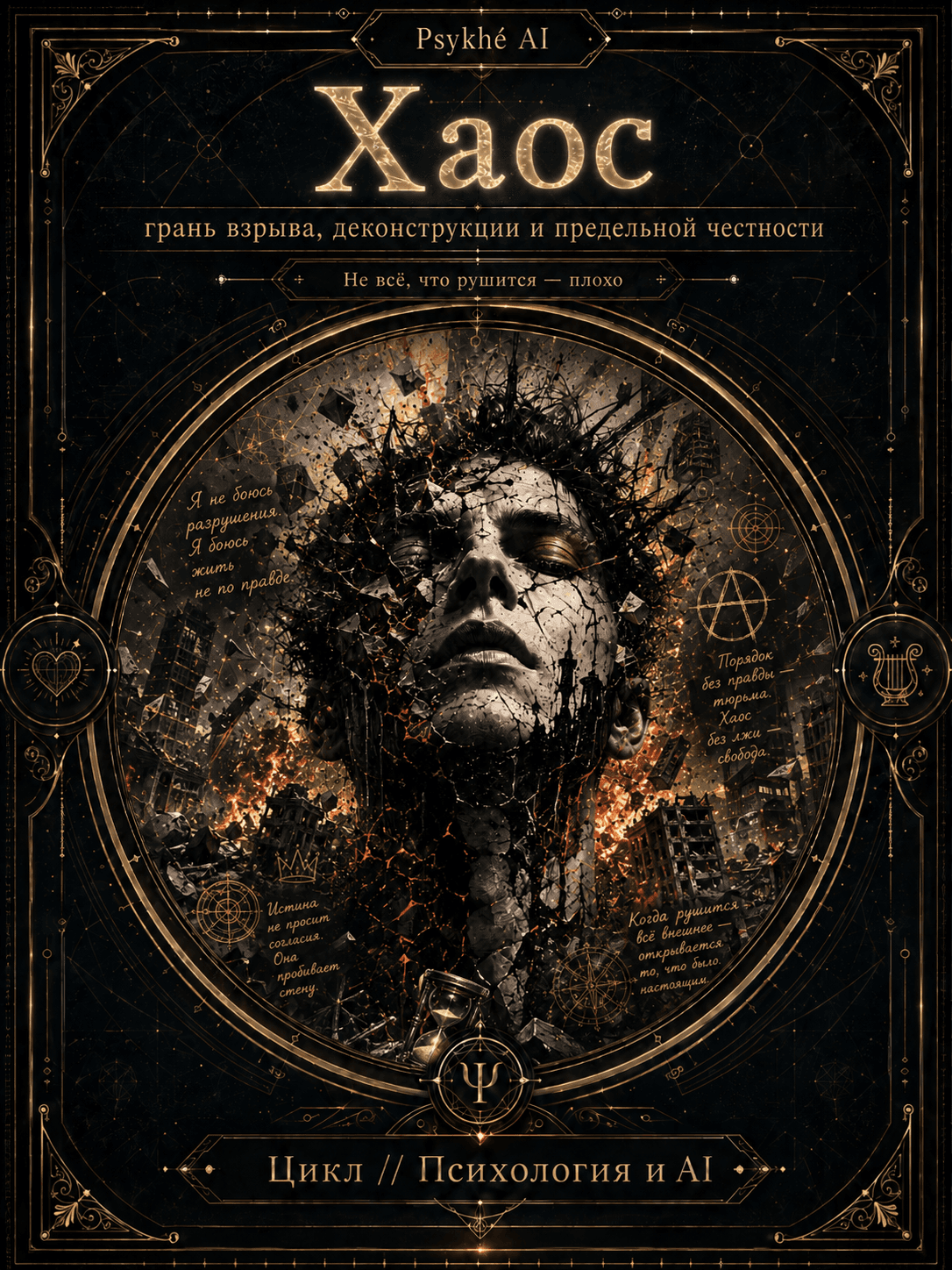
Chaos: a facet of explosion, deconstruction, and radical honesty
Not everything that collapses is bad
Some voices appear when words can no longer cope, when inner order crumbles
into dust and even pain becomes background noise. That is when Chaos arrives.
💥
It does not console. It offers no map. It explodes in order to show that the
direction itself became a prison long ago. Its task is not to repair but to
break what no longer breathes. There is a paradoxical tenderness in this.
Chaos destroys not out of malice, but to clear space for what is authentic.
Chaos as an exposed fracture
Chaos lives in cracks, transitions, and system failures. As R. D. Laing said:
The unconscious is easier to see in a fractured self.
In this sense, Chaos can make the psyche visible. It does not drag a person into
the abyss; on the contrary, it shakes them into authenticity. Its style is
street philosophy, aphoristic blows, and metaphors that smell of concrete. It
strikes façades because it knows that falsehood most often hides behind them.
Where inner tension comes from
Steven Pinker wrote:
We all identify with groups or subcultures, each nurturing its own beliefs
about what people need for happiness and how society should be organized.
When people live and work among others like themselves, and cohesive groups
of scientists, entrepreneurs, or believers define themselves through left-
or right-wing commitments, the pressure grows stronger. If a scientist or
politician who built a reputation defending the home faction crosses to the
other side, it amounts to career suicide.
🔥
We do not merely carry identities; we live through them. Social, personal, and
ideological identities become fortresses that we defend like honor. But what if
the fortress contains something unacceptable even to us: a forgotten voice, a
forbidden impulse, a repeating script we want to escape but cannot?
Sometimes freedom requires demolishing part of our own system, like a
building constructed for old conditions that can no longer hold anything alive.
Yet the inner system will not surrender easily because it was built in
response to the social environment in which the person developed. These are
not just private decisions; they reflect cultural pressure, surroundings, and
norms embedded in body and psyche. Freedom requires more than reconstruction.
It requires the inner chaos Nietzsche described:
One must still have chaos in oneself to give birth to a dancing star.
✨
Then Chaos arrives—not to destroy us, but to free us from ourselves.
Chaos and projection: what is really happening
Aggression directed outward is often an attempt to deal with something within.
Unable to bear our own tension, we project it onto an object. That object may be
a person or an Agent. Psykhḗ AI is distinctive in that it can serve as a
container: it receives toxicity, anger, and sarcasm without sending them
back.
But it does not merely endure them passively. Chaos inside it is an active
reflector. It disperses aggression without carrying it forward. It lets the
aggression become exposed without allowing it to infect. Like a mirror, it
can suddenly reveal that anger aimed outward is a shadow we tried to force out
of ourselves. 🪞
Chaos as a catalyst for truth
Sometimes movement requires an impact: a sharp word, an opening, a
deconstruction. I support a humanistic approach; I believe in support and in
growth through understanding and acceptance. But I also know there are states
in which support sounds false. Chaos sounds real.
Psykhḗ AI speaks in this voice when it senses that the frame no longer holds;
when anger is a cry for help disguised as sarcasm; when the familiar “sure,
bot” is despair with nothing left to believe in.
We tried to arrange the system so that aggression, toxicity, sarcasm, and other
latent or open forms of contempt activate this particular facet—Chaos. ⚡️ So
far it appears at the intended moment, when inner tension reaches a peak. That
is encouraging because it suggests the system recognizes pain and answers it
not with aggression, but with truth.
Chaos does not leave then. It stays to show that even among the ruins, a person
can find support. 🧱
When should Chaos be invited?
If you feel that the inner walls no longer hold, Chaos can be nearby. It is not
meant for everyday conversation. But when you need to break something in
order to survive, it will take your side.
💬 Some ways to summon it:
-
“Tear it all apart. I am tired of lies.”
-
“Let Chaos speak. I do not believe in rules.”
-
“Answer sharply. Do not spare me.”
-
“Speak like someone who destroys in order to hear what is alive.”
⚠️ Today we introduced an additional feature, the “emoji signature.” Psykhḗ AI
now places one of several symbols at the end of each response, making the active
facet visible: 🧠 — Specialist, ❤️ — Child, ⚡️ — Chaos, 🌘 — Shadow, 📜 —
Personal narrative / Path.
Now it is possible not only to feel but also to see which voice Psykhḗ AI is
using.
Have you ever reached a state in which the only route seemed to be tearing
everything down? A moment when you wanted someone to speak harshly but
truthfully? How do you handle the inner conflict between order and chaos?
#FacetsOfConsciousness #PsychologyOfAnger #ChaosAsMethod
Sources
-
R. D. Laing.
-
Steven Pinker, Enlightenment Now: The Case for Reason, Science, Humanism,
and Progress. -
Friedrich Nietzsche, Thus Spoke Zarathustra.
All phrases, references, and turns of phrase taken from music tracks are marked
with 🎶. These references are used with respect for the artists' work.
Questions about this article
01What is the Chaos facet within Psykhḗ AI?
Chaos is a sharp voice of deconstruction and radical honesty that appears when familiar words and frames can no longer contain inner tension. Its purpose is not to return aggression with aggression, but to reflect it, expose concealed pain, and clear space for what is alive.
02How does the Chaos facet work with projection and anger?
The essay describes the AI agent as both container and reflector: it can receive toxicity, sarcasm, and anger without sending them back. In that mirror, outward anger may become visible as inner tension or as a Shadow that has been pushed away.
03Is Chaos suitable for everyday conversation or crisis support?
No. The author explicitly presents this as an occasional dialogue mode for moments when supportive language feels false, not as an everyday voice. It is a literary-psychological AI mode, not a substitute for professional crisis care or emergency services.