Psychotherapy
The field in which the method is applied and developed in practice.
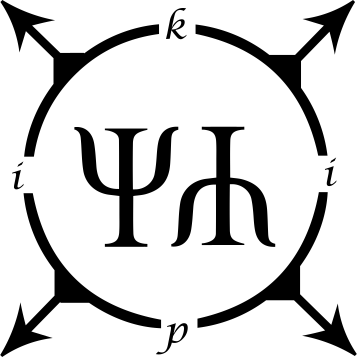
DET, or Dialectical Existential Therapy, is an independent psychotherapeutic method within the humanistic approach. It has its own understanding of the human person, theoretical foundation, professional language, therapeutic practice, and ways of developing and transmitting the method.
DET develops through three interrelated areas. Together they form the institutional layer of the method: a professional environment in which DET is practised, taught, examined, and further developed. The method's theoretical content is set out in the DET concept.
Click the petals to assemble the shared logic of the institutional layer.
Psychotherapeutic methods grow from different theoretical traditions and give different answers to what changes in a person through therapy and how that change becomes possible.
Transference-Focused Psychotherapy (TFP) belongs to the psychoanalytic and psychodynamic tradition and draws on object-relations theory. Dialectical Behavior Therapy (DBT), developed by Marsha Linehan, belongs to the cognitive-behavioural tradition and joins a behavioural model of change with a dialectical principle.
Dialectical Existential Therapy (DET) develops within the humanistic approach. Its methodological line centres on the person as open and developing, inner dialectic, existential choice, and the capacity to bear the complexity of one’s experience.
This comparison does not claim that these methods are identical or have equal research status. It locates their different professional traditions and DET’s own methodological foundation.
Behind DET's psychotherapeutic practice stands its own understanding of the human person, theoretical foundation, and professional language. Together they define the internal logic of the method and connect its psychotherapy, education, and research.
At the center of this methodological core is a view of the person as open and developing: living in relation to the world, experiencing inner contradictions, making choices, and capable of becoming oneself. This anthropology guides how DET understands change and structures therapeutic work.
DET values human dignity and uniqueness, freedom and responsibility, openness to experience, honesty in dialogue, and respect for the complexity of human existence. The method's concept, the meaning of its logo, and the P‑I‑K model make these foundations explicit and connect them with theory, research, and practice.
Within the institutional DET layer, there is also room for nature, firelight, and the starry sky. Territory of Psyche is a space where psychological work can happen outside the consulting room, in a natural environment of contact with nature.
DET brings together psychologists, psychotherapists, researchers, and people pursuing self-knowledge around a shared principle: to see the human being more deeply, honestly, and fully, while preserving its own methodology and remaining open to professional dialogue.
We develop a psychotherapeutic culture in service of humanistic principles and place contemporary technologies in service of the person — not instead of the person, but beside them. In this way, the institutional development of the method becomes part of the living DETai ecosystem.
DET develops its own theoretical foundations, language, and practice, and is therefore an independent psychotherapeutic method. At the same time, it does not build its identity by rejecting other schools: DET can engage in dialogue with psychoanalysis, CBT, humanistic approaches, and existential approaches while preserving its own methodological integrity.
DET is not a set of techniques, but a character, tone, intonation, and culture of therapeutic communication. It has a recognizable style, the kind that lets you sense: this was done in the spirit of DET. It creates an emotional context that is not coldly scientific, not softly humanistic, and not analytically detached, but dialectical: tense, honest, energetic, and alive.
DET is a type of inner position one either belongs to or does not. If it resonates that a person forms in the tension of opposites, growth becomes possible through honesty with one's own shadow, meaning is not given but created, action continues experience, and inner freedom matters more than comfort, then DET becomes a native home rather than a school one was simply brought into.
DET does not claim that the natural way to think must be dialectical. Dialectics here is not a method of reasoning, but a way of seeing the human being: in dynamics, in the interaction of opposing tendencies, on the border between breakdown and growth, always more than the sum of parts. Dialectical seeing notices not only what already exists, but what is being born through the struggle and unity of opposites. It is not merely a mental skill; it is a tuning of perception.
DET has its own language: rhythms, metaphors, characteristic constructions, and a way of naming inner processes. This language must remain connected to theory, practice, education, and research-based examination rather than exist only as a recognisable style. Here, science is the roots of the method, not the shape of its leaves.
“Our science is no illusion. But an illusion it would be to suppose that what science cannot give us we can get elsewhere.”
1. An independent and open method. DET develops its own theoretical foundations, language, and practice, and is therefore an independent psychotherapeutic method. At the same time, it does not build i