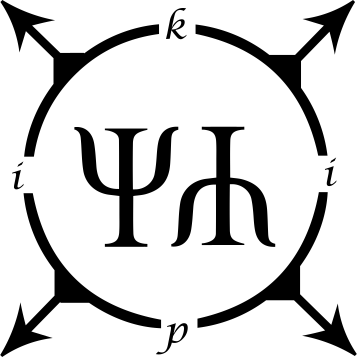
DET Symbol
DETai Logo: a dynamic model of personality
The DETai logo emerged from an attempt to express visually one of DET's central ideas: personality develops not by eliminating inner opposites, but by learning to recognize, hold, and transform their tension. Its form unfolds in sequence: a point becomes a circle, the circle opens to the world, opposing forces appear within it, expansion reaches the edge of rupture, and P-I-K helps preserve openness and integrity at the same time.
I. The logo not as a sign, but as a process
The DETai logo should not be understood as an ordinary emblem. It does not merely denote an organization, a direction, or a brand. It is organized differently: it is a condensed model of personality formation, a visual formula of dialectical existential therapy.
An ordinary logo says: “this is who we are”.
The DETai logo says: “this is how a person becomes”.
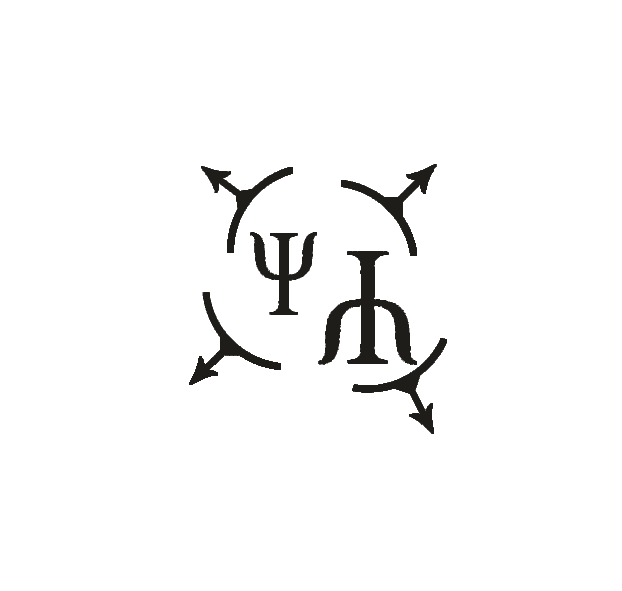
What matters in it is not only the final image, but also the path of its unfolding. The final form is not a static seal, but the trace of a process: the point was born in darkness, the circle emerged as the first boundary of personality, inner duality grew from one ground, the gaps opened the person to the world, the amplitude of experience increased, the structure almost fell apart, but was held by principles, humanism, and knowledge. That is why the logo is not static even when we see it as a PNG. A static image is only a stopped frame of living movement.
In this sense, the DETai logo is a psychosemantic model: each part of it is not a decorative element, but a semantic unit. The point, the circle, the gaps, the two inner figures, growth, rupture, P-I-K, and the final pulsation are not ornaments; they are stages of inner life. The logo shows not an ideal person, but a person passing through dangerous becoming: becoming larger, more complex, deeper — without destroying oneself through this growth.
The central formula can be stated like this:
Personality grows not from purity, but from processed complexity.
DET does not propose a sterile psyche cleansed of shadow. Nor does it romanticize darkness. Its task is subtler: to help a person withstand their own inner amplitude, without suppressing either light or shadow and without giving either side total power.

II. The circle of personality: boundary, container, first form of the “I”
1. The point in darkness
The unfolding of the logo begins with a dark field and a point. This is not merely visual minimalism. Darkness here is not emptiness, but the space before a formed “I”. There is not yet personality as a structure, no circle, no internal architecture, but there is already possibility. The point is the first impulse of presence.
It does not say, “I am already whole”. It says: “I can become.”
It is the seed of personality. The first flash of consciousness. The moment when a center begins to separate from the unformed. In therapeutic terms, this is the beginning of subjectivity: the person does not yet understand themselves, but there is already a point within them from which form can grow.
The point in darkness is also important because DET does not begin from a ready-made norm. It begins from uncertainty. From the place where a person is not yet assembled, but already exists as the possibility of movement.
2. The point becomes a circle
When the point expands, the circle is born. The circle is the first form of personality, the first boundary between “I” and the world. Without a circle there is no container, no inner space, no ability to distinguish: this is mine, and this is not mine; this is happening inside me, and this is coming from outside; this is my impulse, and this is the voice of the environment, trauma, family, culture, or fear.
The circle is not a prison. It is a necessary form. To be open to the world, one first needs something that can open. To receive the other, one needs a center that will not dissolve at the first foreign influence.
Therefore, the circle in the logo symbolizes personality, psyche, container, boundary, and form. It marks the human “I” not as a frozen essence, but as a growing shell capable of expanding together with experience.
But the circle has a double nature. On the one hand, it protects. On the other, it can become a capsule.
If the circle is too closed, a person is stable but impoverished. They risk disintegration less, because they let almost nothing in. They may be socially convenient, outwardly proper, even “innocent”. But closed innocence is not yet virtue. A person may refrain from doing evil simply because they never enter the risk zone, never meet their own shadow, never try to carry real strength, never encounter contradiction, and never make a choice where choice is painful.
A closed circle preserves form at the cost of impoverishing life.
III. Gaps in the circle: a mature psyche is not hermetic
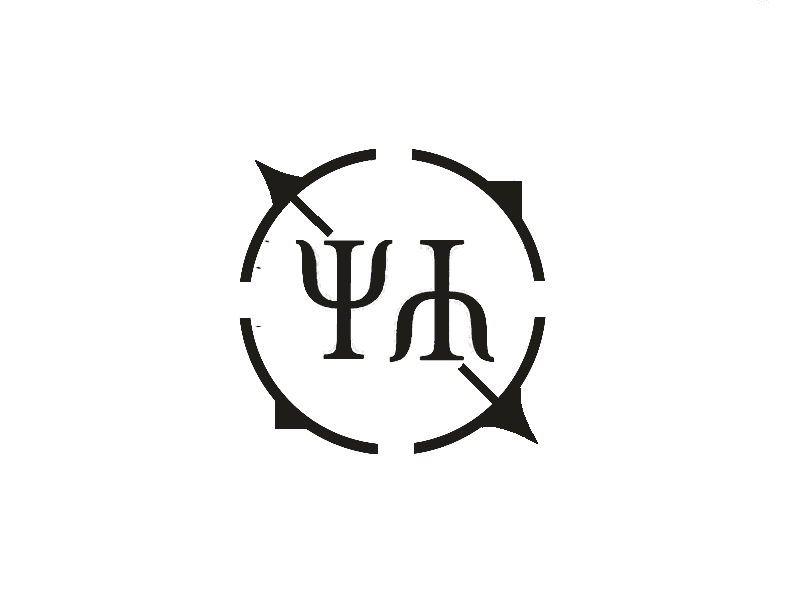
One of the strongest symbols of the logo is the gaps in the circle. At first glance, they may look like damage to the form. But in the logic of DET, this is not a breakdown. It is a condition of life.
A person is not a closed system. A person breathes the world. Through the gaps, the other enters: love, fear, sadness, guilt, delight, embodiment, culture, another point of view, trauma, knowledge, language, art, death, God, technology, another person.
The gaps mean: personality does not need to be hermetic in order to be whole.
This is fundamental. In the classical image of wholeness, there is often a temptation to imagine a mature person as a perfectly closed circle: everything in place, boundaries smooth, nothing leaking. DET thinks maturity differently. Maturity is not impermeability. Maturity is controlled permeability.
A closed psyche is protected, but develops poorly. A completely open psyche can lose itself. Therefore, the task is not either to close down or to dissolve. The task is to become an open system capable of taking in heterogeneous experience and processing it without losing form.
The gaps in the circle are the gates of life. But gates require walls. If there is only a wall, there is no development. If there are only gates, there is no home.

IV. Two inner opposites: shadow and light as engines of growth
Inside the circle appear two inner figures, two opposing forces. They can be read through different languages:
shadow and light;
Eros and Thanatos;
conscious and unconscious;
body and spirit;
passion and conscience;
creation and destruction;
order and chaos;
the Apollonian and the Dionysian;
the will to live and the knowledge of death.
It is important not to reduce them to the banal opposition of “good” and “bad”. In DET, shadow is not simply evil, and light is not simply good. The structure is more complex.
Shadow is the repressed, painful, unacceptable, frightening, but also energetically charged. It may contain aggression, envy, shame, sexuality, fear, the thirst for power, pain, hatred — but also vitality, honesty, strength, instinct, the ability to defend oneself, and the ability to desire. Shadow is dangerous not because it exists, but because it is unconscious. A suppressed shadow does not disappear; it begins to act by indirect routes: through projections, self-punishment, moralizing, bursts of destructiveness, sterile “correctness”, contempt for the living, and the desire to control everything.
Light is not simple either. Light may be love, meaning, principle, consciousness, care, faith, humanism. But hypertrophied light can become the searchlight of interrogation. It may turn into violence against oneself: “I must be good”, “I have no right to be angry”, “there must be nothing low in me”, “I must be pure”. Such light does not integrate shadow; it declares war on it. And the more strongly it suppresses shadow, the more strongly shadow returns.
Therefore, the task of DET is not the victory of light over shadow and not capitulation to shadow. The task is productive holding of opposites.
Shadow becomes an ally not when it is allowed to destroy, but when it is heard, named, translated, and included in the system of conscious choice. Light becomes mature not when it denies darkness, but when it can illuminate it without becoming tyranny.
Development happens not by eliminating one side, but through the capacity to hold the tension between them. Personality becomes deeper not when one part is finally suppressed, but when both sides are sufficiently recognized for a living amplitude to arise between them.
V. The full unfolding cycle of the logo
1. Dark field: pre-formed space
At the beginning there is no ready-made person. There is darkness as uncertainty, as being not yet structured. This is not negative darkness, but primary darkness. Everything can be born from it, but nothing has yet been assembled.
2. Point: the first impulse of consciousness
The point appears as a minimal sign of presence. It does not yet possess complexity, but it already disrupts emptiness. It is the beginning of subjectivity: “I am”, “I can respond”, “form can arise in me”.
3. Expansion of the point into a circle: birth of the personality container
The point expands and becomes a circle. This is how the primary boundary of personality appears. The circle creates the possibility of inner space. Now something can happen inside. The psyche receives a form capable of holding experience.
4. Inner point: the seed of the becoming “I”
The appearance of an inner center shows that personality is not only a shell. It has a core. This is not the final self, but the germ of inner organization from which different forces can grow.
5. Growth of two opposites
Two inner figures arise from one ground. They grow in parallel, without the final domination of one over the other. This is crucial: the opposites do not appear as two random enemies. They grow from one root. Shadow and light belong to one psyche. They are not strangers to each other.
6. Gaps and arrows: personality opens to the world
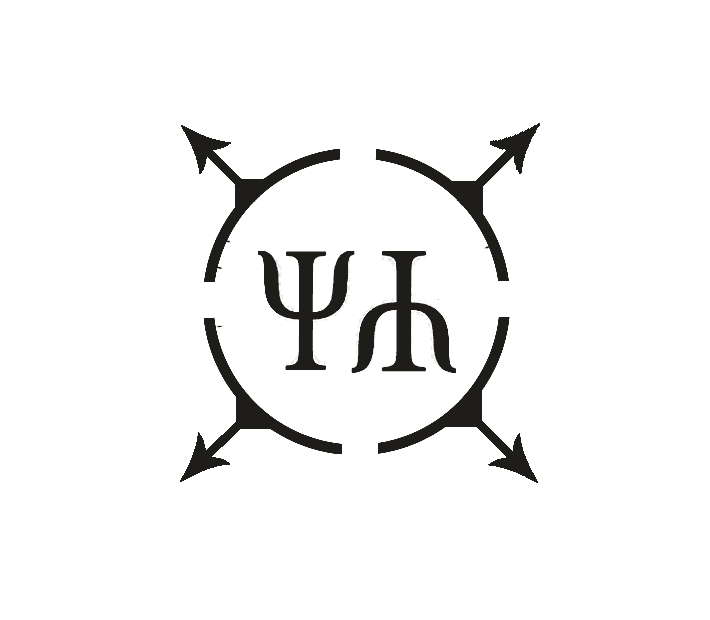
As the circle develops, gaps appear in it. Experience enters through them. Arrows moving in different directions show the expansion of personality. The person goes beyond the limits of the former form. The person can no longer remain a small closed circle. The person begins to take in life.
But this growth is double. What expands personality also places a load on its integrity. The arrows do not merely decorate the circle; they pull it in different directions. They show that development always carries risk.
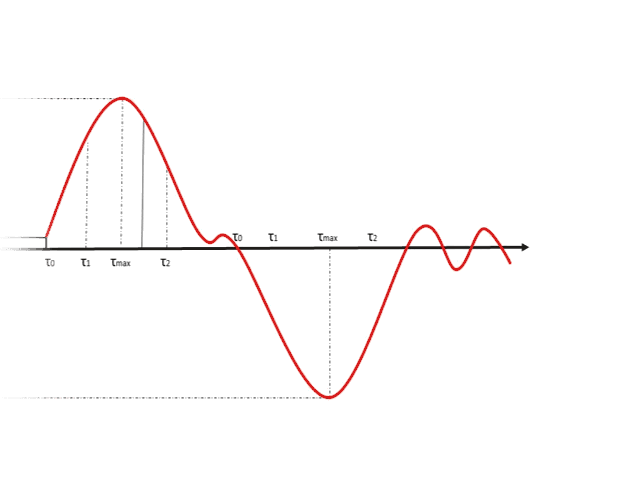
7. Growth of amplitude: life becomes more voluminous
As the opposites grow, the amplitude of experience increases. A person can rise higher and fall lower. Their life becomes more voluminous: joy becomes richer, pain deeper, love stronger, anxiety sharper, meaning more demanding.
Here a key idea appears: the fullness of life is defined not by one peak, but by range. Not by how high a person once rose, but by what volume of experience they can endure and integrate.
But high amplitude is not a romantic gift. It is dangerous energy. The wider the inner range, the greater the demands placed on the container. The more a person takes in, the more they need principles, knowledge, structure, bodily stability, an ethical center, and the capacity to overcome.
8. The edge of rupture: gaps can become disintegration
At a certain moment, the growth of the circle and the growth of inner opposites reach a dangerous boundary. The gaps that were windows can become cracks. Openness, which was a condition of development, can turn into loss of form. The circle begins to stretch so far that the risk of losing integrity appears.
This is the moment when a person almost cannot withstand their own expansion.
It is important to understand: disintegration does not necessarily come from a “bad” shadow. Disintegration can come from any hypertrophy. From shadow without light. From light without shadow. From knowledge without humanism. From humanism without knowledge. From principles without openness. From openness without principles. From body without spirit. From spirit without body. From freedom without form. From form without freedom.
Distortion is not merely a moral error. It is a structural threat.
9. Appearance of P-I-K: structure enters at the moment of danger
P-I-K appears precisely at the point of risk. Not at the beginning, when the circle is still small. Not after collapse, when structure has already failed to hold. But at the moment when personality almost exceeds its own ability to remain itself.
This is the most delicate logic of the logo. If P-I-K appears too early, it can become armor: principles turn into dogma, knowledge into intellectualization, humanism into a soft denial of conflict. Then the gaps are plugged too early, and the new cannot enter. Personality remains safe, but does not expand.
But if P-I-K appears too late, amplitude can already tear the circle apart.
That is why P-I-K appears precisely at the edge. It is not a lid placed over the psyche. It is the reinforcement ribs of an open living system.
| In life | In the model | In philosophy |
|---|---|---|
| Principles | P (principles) | Axiology |
| And (instead of or) | i | Humanism |
| Knowledge | K (knowledge) | Epistemology |
Section VII develops this triad in more detail.
10. Elastic gathering: stabilization without closure
After P-I-K appears, the structure does not return to its former small form. It does not become sealed. It stabilizes. This distinction is important.
Stabilization in DET is not freezing. It is the ability to remain open, but not torn apart. Personality keeps its gaps, because without them there is no life. But now the gaps no longer destroy the circle. They become part of a mature architecture.
11. Final pulsation: the psyche continues to breathe
The final pulsation of the logo means that wholeness is not immobility. A mature personality does not become a stone. It continues to expand and contract, to receive and process, to enter contact and return to itself.
Pulsation is the breathing of the psyche.
It is the heartbeat of a living structure.
It is the sign that development does not end in the final form.
The final logo remains open and pulsating, because maturity in DET is not closed completion, but stable incompletion.
VI. Alternative branches of development: closure, distortion, rupture, productive trajectory
1. Closed circle: stability without depth
The first alternative branch is the closed circle. This is a person who maintains integrity by limiting experience. They do not allow in too much pain, too much shadow, too much otherness, too much risk.
This way should not be despised. It can be adaptive. Sometimes the psyche closes in order to survive. Sometimes a person is not ready for high amplitude, and a premature opening of shadow can be destructive.
But if closure becomes the main mode of existence, development stops. The person preserves form, but loses volume. They avoid disintegration at the cost of narrowing life.
A closed circle does not fall apart because it does not live widely enough.
2. Distortion: hypertrophy of one part
The second branch is distortion. It arises when one side of personality is cultivated while the other is suppressed.
If shadow is suppressed, the person may become “correct” but lifeless. Their light becomes sterile. They begin to fear everything impulsive, bodily, aggressive, passionate. They may speak the language of morality while accumulating unrecognized destructiveness inside.
If light is suppressed, the person may identify with shadow. Then they begin to justify destruction through honesty: “this is who I am”, “this is my nature”, “I am simply not being hypocritical”. But this is not integration of shadow. It is surrendering governance to shadow.
If the body is suppressed, spirit becomes a disembodied abstraction. If spirit is suppressed, the body becomes rough mechanics. If knowledge is suppressed, humanism loses form. If humanism is suppressed, knowledge becomes a cold cage.
Disintegration is possible not only from the “bad” part. Disintegration is possible from any part that declares itself to be the whole.
3. Rupture: amplitude without a container
The third branch is rupture. This is a situation where personality lets in too much, too quickly, without a sufficient container. The gaps become too large. The circle loses its holding function. Inner opposites grow, but are not integrated. Amplitude becomes not a source of development, but a centrifugal force.
In clinical, existential, or everyday terms, this may appear as loss of support, chaoticization, breakdown, movement into extremes, collapse of self-image, or a feeling of abyss. The person no longer merely experiences shadow — they are seized by it. Or they do not merely strive toward light — they burn themselves with the demand for purity.
It is important not to romanticize the edge. Walking along the edge can be a source of knowledge, but the edge is not valuable in itself. The value is not to fall into the abyss. The value is to approach depth and return with new knowledge.
4. Productive trajectory: openness, amplitude, overcoming, P-I-K
The productive trajectory is not “normal development” in a dull normative sense. It is better to call it a trajectory of held expansion.
The person remains open. They let in shadow, but do not give it power. They recognize light, but do not turn it into tyranny. They experience high amplitude, but do not make a cult of it. They meet chaos, but structure it. They do not close too early and do not open so widely that they disintegrate.
Such a person does not become simple. They become gathered.
VII. P-I-K: principles, “and”, knowledge
P-I-K is not a signature under the logo and not a decorative abbreviation. It is a semantic mechanism of stabilization.
Even the sound matters: P-I-K appears at the peak. At the peak of expansion, at the peak of amplitude, at the peak of risk. When the circle almost ruptures, what can keep personality open and alive appears.
P — Principles / principles / axiology
P stands for principles. But not external morality, not a set of prohibitions, not social training. In the logic of DET, principles are an inner axiological support: that for the sake of which a person does not give themselves over to chaos.
Principles answer questions:
What is unacceptable for me?
For the sake of what do I endure tension?
What value keeps me from destroying myself and another?
Where is my boundary?
What do I choose when there is both light and shadow in me?
Without principles, high amplitude becomes dangerous. A person can feel much, understand much, desire much, suffer much, but without an axiological center this “much” does not gather into personality. It becomes a storm.
Principles do not kill shadow. They prevent shadow from becoming a dictator.
I / “and” instead of “or” / humanism
The middle element is the most subtle. It is not just a letter. It is an operator of connection.
And instead of or.
Not shadow or light, but shadow and light.
Not body or spirit, but body and spirit.
Not order or chaos, but order capable of holding chaos.
Not human or technology, but human and technology.
Not pain or meaning, but pain that can be processed into meaning.
This “and” is the humanistic core of DET. It does not cut the psyche in half. It refuses primitive binarity, but does not dissolve differences into gray mush. “And” does not say that everything is the same. It says that wholeness is born not from exclusion, but from relation.
Humanism here is not soft kindness and not a refusal of rigor. It is the capacity to see a person as larger than a single impulse. A person is not equal to their shadow. But neither are they equal to their bright mask. A person is larger than both sides, because they can hold them together and choose an action.
The formula is simple:
Sensitivity is universal, while actions are a choice.
A person can feel many things. Darkness, rage, fear, the desire to destroy, the desire to disappear may rise within them. But between experience and action, a space appears. It is precisely there that human dignity arises.
K — Knowledge / knowledge / epistemology
K stands for knowledge. But not dry information and not intellectual armor. Knowledge in DET is the ability to name what is happening, see structure, distinguish processes, recognize patterns, understand cycles, and build a map of the inner world.
When a person experiences a storm, they often do not know what is happening to them. Then experience becomes absolute. Anxiety says: “this is forever”. Shadow says: “this is who you are”. Light says: “you have no right to feel this”. Knowledge creates distance: this is a process, this is a pattern, this is amplitude, this is defense, this is projection, this is a script, this is overload, this is rollback, this is growth, this is a point of risk.
Knowledge does not replace experience, but makes it bearable.
Without knowledge, a person drowns in experience. Too many feelings without a map turn into chaos. But knowledge without humanism is also dangerous: it can become a cold cage, classification instead of encounter, a scheme instead of a person.
Therefore P-I-K works only as a triad.
Principles without openness become armor.
Openness without principles becomes disintegration.
Knowledge without humanism becomes cold control.
Humanism without knowledge becomes softness without form.
“And” without principles can become permissiveness.
Principles without “and” become dogma.
P-I-K does not close the circle. It makes openness bearable.
VIII. The connection between the logo and the three postulates of DET
The DETai logo is, in fact, a visual compression of the three postulates of dialectical existential therapy.
1. “Shadow and light”
The first postulate is the core of the logo. The two inner figures show that a person lives between opposites. Development begins not by eliminating conflict, but by recognizing inner duality.
Shadow and light are not enemies, but poles of one system. Maturity is born from their tension. Shadow gives energy and knowledge of what has been repressed. Light gives direction, meaning, and ethical form. Their meeting creates not comfort, but depth.
2. “Personality types”
The second postulate shows that different people organize inner amplitude in different ways. A personality type is not a label and not a prison, but a way in which the psyche copes with heterogeneity of experience.
One person closes and lowers amplitude. Another lives in high oscillations. A third moves into rationalization. A fourth transforms tension into action. Type is a map of how personality holds or fails to hold its own expansion.
The logo shows the general mechanism; the postulate of types shows different trajectories within this mechanism.
3. “Overcoming mindset”
The third postulate answers the main question: what does a person do when tension becomes strong?
They may discharge it through destruction.
They may close down.
They may suppress one part.
They may disintegrate.
Or they may endure and transform.
The overcoming mindset is the capacity not to cancel difficulty, but to turn it into movement. Not to deny pain, but to process it. Not to avoid shadow, but to enter into work with it. Not to eliminate amplitude at any cost, but to learn to live so that high amplitude becomes a source of growth.
The values of DET directly affirm the right to contradiction, the understanding of difficulties as material for development, and faith in the human potential to endure, transform, and grow.
Thus the three postulates join into one dynamic:
Shadow and light create inner tension.
Personality types show forms of reaction to this tension.
Overcoming mindset determines whether tension becomes disintegration or development.
IX. DETai as an ecosystem: an external container for high inner amplitude
The logo describes not only an individual person. It also describes the DETai ecosystem itself.
DETai can be understood as an external container for processes that are often too large, chaotic, or overloaded inside a person to be held by spontaneous reflection alone. If DET works with the inner dialectic of personality, DETai creates an external infrastructure that helps this dialectic be seen, written down, structured, and returned to conscious form.
AI interfaces in this logic are not a replacement for the person, not a replacement for psychotherapy, and not a removal of responsibility. They are external supports of structuring. They help bring outward what spins too quickly inside: thoughts, images, contradictions, scripts, posts, symptoms, impulses, categories, connections, maps, diary fragments, research hypotheses.
For a person of high amplitude, this is fundamental. When there is much light and much shadow inside, many ideas and much pain, many meanings and much chaos, the psyche needs additional forms of holding. Not because it is weak, but because its range is large. The higher the amplitude, the more important the container.
DETai as an ecosystem can perform several functions:
it becomes an archive of inner experience;
a mirror that returns a person’s material in a more gatherable form;
a map where chaos turns into connections;
a methodological frame where experience receives language;
an AI-augmented environment where speed of thought does not necessarily lead to disintegration;
a space where “and” is stronger than “or”.
This is why the connection between DET and AI is not an external fashion. It corresponds to the very logic of P-I-K. AI helps strengthen K — knowledge, map, structure. The ecosystem helps hold P — principles and value frameworks. And the humanistic orientation of DET holds the central i — “and”, so that technology does not replace the person, but serves the person.
The current architecture starts from a different definition: DET is an independent psychotherapeutic method within the humanistic approach. In the DETai ecosystem, methodological, institutional, and technological contours interact while technology remains in the service of the person. A person in this architecture thinks through “and,” joining technology and humanism, shadow and light, depth and speed.
In this sense, DETai is the logo unfolded into infrastructure.
The circle is the person and the community.
The gaps are interfaces with the world.
The two inner forces are shadow and light in the human psyche, as well as the humanistic and technological principles.
P-I-K is methodology, ethics, knowledge, and the humanistic operator “and”.
Pulsation is the constant development of an ecosystem that does not close into dogma.
DETai should not become a hermetic system. It should remain open, but structured. Otherwise it will either close into a school that stops taking in the new, or dissolve into the chaos of technologies without a therapeutic center.
X. Final logo: the sign of held tension
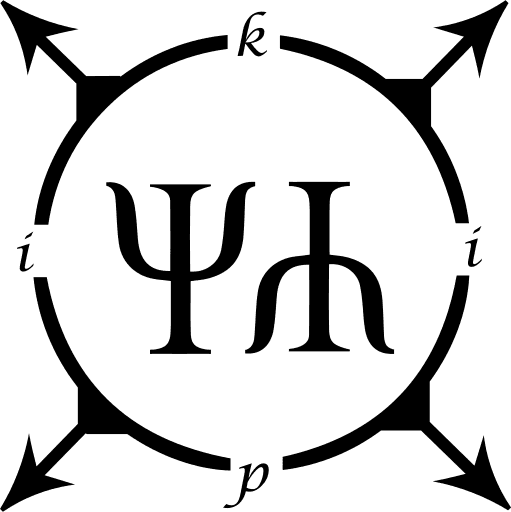
The final DETai logo is not a sign of rest. It is a sign of held tension.
It says: a person does not have to be simple in order to be whole.
A person can be contradictory and not fall apart.
A person can have shadow and not be shadow.
A person can strive toward light and not violate themselves with light.
A person can be open to the world and not lose form.
A person can experience high amplitude and not turn it into a cult of destruction.
A person can use knowledge and not become a cold scheme.
A person can have principles and not become closed dogma.
A person can connect psychology and AI, depth and speed, humanism and technology.
In this logo, maturity is not depicted as perfect symmetry. It is depicted as a living structure that has passed through the threat of rupture and learned to pulsate.
There is no naive optimism here. DET knows that shadow can destroy. Light can also destroy. Knowledge can dehumanize. Principles can petrify. Openness can tear apart. That is precisely why dialectical therapy is needed: not to remove danger from life, but to learn to transform danger into development.
The DETai logo can be read as a small drama of personality:
the point wanted to become a circle;
the circle wanted to become larger;
the larger demanded that the other be admitted;
the other brought shadow;
shadow gave energy;
light gave direction;
amplitude almost tore the form apart;
principles, humanism, and knowledge held the personality;
after that the sign did not die and did not freeze — it began to breathe.
That is why the final form remains open. Because a fully closed personality no longer develops. And a fully opened personality no longer holds itself. Maturity is found between these extremes: in the ability to be open without disintegration, strong without cruelty, light without sterility, dark without possession, knowledgeable without coldness, principled without dogmatism.
The DETai logo is a symbol of the psyche that does not choose between shadow and light, but learns to become large enough to contain both poles and transform their tension into a path.
Short preamble for further reading
The philosophy report available as a PDF does not describe the logo itself or P-I-K. It serves as one conceptual source for this authorial interpretation by examining the dialectic of good and evil, the interaction of Eros and Thanatos, the tension of opposites, and the possibility of turning inner conflict into a resource for development.