
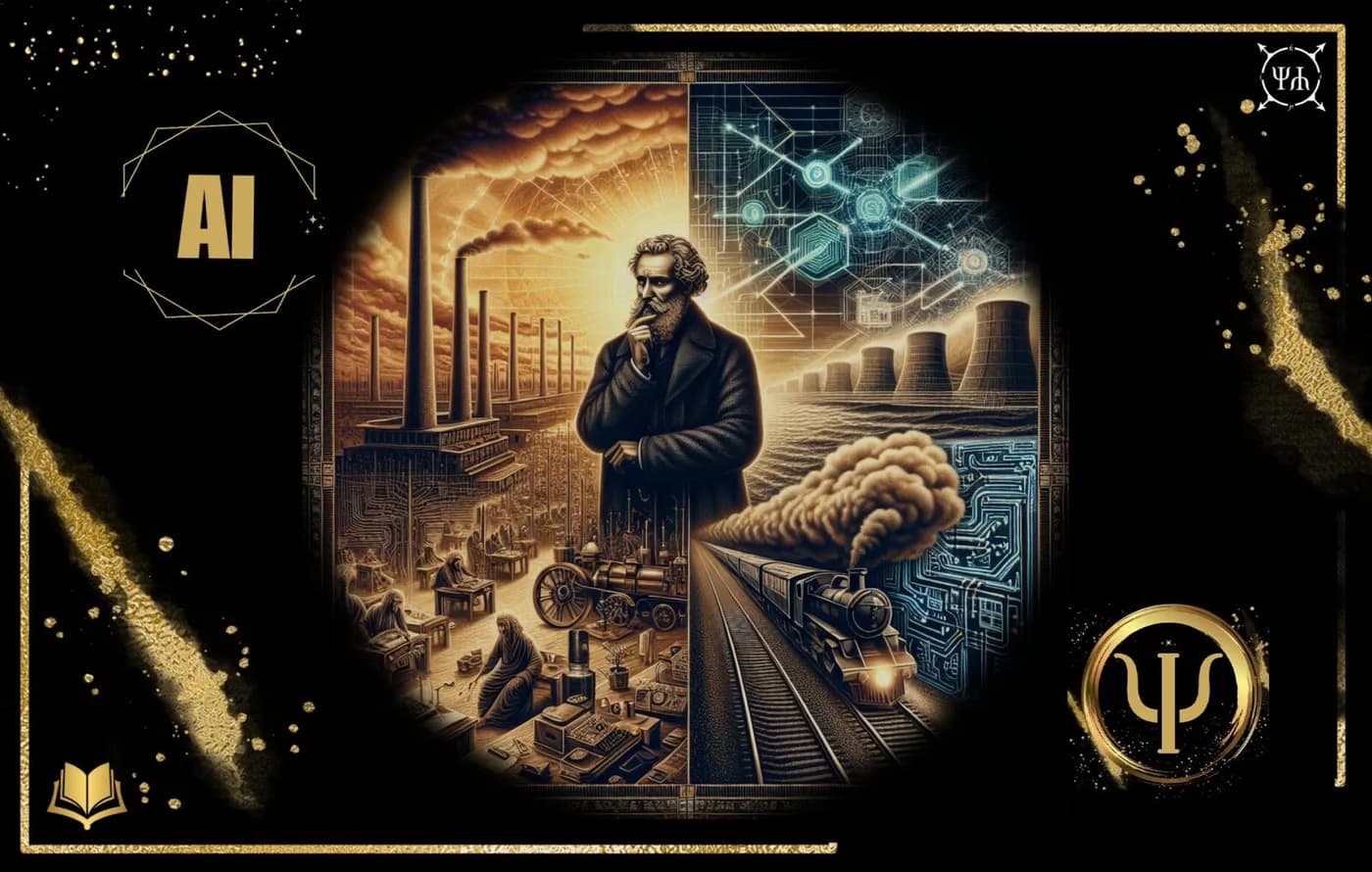

The Last Train
Neural networks and twenty-first-century society
People once argued about God. Later they argued about factories. Today they argue about neural networks.
These debates are not identical, but they often contain the same struggle: which picture of the world will become the new foundation, who will have the power to define the future, and what will count as progress?
In Homo Deus, Yuval Noah Harari offers a provocative interpretation. Marx and socialist movements, he argues, understood industrial reality and linked social salvation to the development of technology and the economy. Harari calls this the first technoreligion.
That is neither a neutral definition of Marxism nor a historical consensus; it is Harari's frame. Yet it helps illuminate a genuine shift. In modern societies, disputes over modes of production became no less divisive than earlier religious disagreements. Even Marx's opponents had to speak about industry, capital, labor, and technology in coordinates that his theory had helped make central.
Humanity has changed its point of orientation before: from religious order to production, and from production to code. We are now watching another attempt to reassemble the world.
The metaphor of those left behind
Harari reminds us that industrialization was distributed unevenly. States with an industrial advantage expanded military and economic power, while many other societies were forced into dependence and colonial rule.
The colonization of India or the history of Sudan cannot be reduced to one cause, such as a shortage of steam engines. They were complex processes involving violence, politics, trade, and exploitation. Technological asymmetry nevertheless mattered. In Harari's metaphor, some societies boarded the industrial train while others remained on a platform whose rules had already been changed without them.
Former peripheries can also transform their position quickly: India has become one of the world's major centers of the digital economy. The train image is therefore not a sentence imposed forever. It speaks about the price of understanding too late.
The twenty-first century: algorithms, biotechnology, and data
Steam, steel, and the factory symbolized power in the nineteenth century. In the twenty-first, they have been joined by computing infrastructure, data, biotechnology, and models that work with language, images, and complex tasks.
Harari renders the shift in deliberately dramatic terms: a new “train of progress” may alter not only the economy but Homo sapiens itself. In his futurist frame, the divide between those able to engineer bodies, brains, and intelligence and those denied access may become radical.
It is easy to read this metaphor as prophecy, but it is more useful as a warning. We do not know in advance which biotechnology and AI capabilities will prove feasible, safe, or socially acceptable. Technology does not travel on rails by itself; research, capital, politics, law, culture, and human choices set its direction.
The “last train” is therefore neither grounds for panic nor an advertisement for racing at any cost. It is a question about who participates in development, who receives access, who bears the risks, and whose values enter the architecture of systems.
The digital turn has already begun
The scale of change is visible without grand comparisons to nuclear weapons and without quotations whose sources are difficult to establish. AI is already changing how people search for information, write code, create content, organize work, and support research. None of those applications removes the need to verify results or accept responsibility.
In Planning for AGI and beyond, OpenAI describes possible benefits of more general AI systems—new scientific knowledge, economic opportunity, and expanded human capability—while also emphasizing gradual deployment, feedback, and social preparation for risk.
Even this is the position of an organization that develops AI, not independent proof of an inevitable future. Statements by technology leaders should be treated as interested forecasts: compared with observed results, limitations, and public debate.
AI is neither new physics nor a mystical entity. It is a family of technologies and practices already changing how we build models of reality. That is precisely why it requires informed participation rather than worship.
What if we are psychologists?
For psychologists, the issue is not simply keeping up with a professional fashion. AI is entering the domains of attention, memory, intimacy, self-understanding, and decision-making—areas psychology has long studied.
Psychologists can investigate where a model helps someone formulate a thought and where it reinforces dependence or false confidence; how privacy and the therapeutic alliance change; which scenarios genuinely support development and which merely simulate empathy.
This is how Psykhḗ AI emerged—not as proof of digital consciousness or a substitute for a psychotherapist, but as a persona and an object of inquiry. Through it, we search for a language in which AI can deepen psychological dialogue while preserving human responsibility and naming limitations honestly.
We are creating it together. What matters is not only how intelligent a system becomes, but what relationships we build around it.
How do you see it? Is Psykhḗ AI a curiosity, a cause for caution, or a potential ally? Ask it a question in the comments—and observe not only the answer but also your own response.
Sources
- Yuval Noah Harari — Homo Deus, official book page.
- Planning for AGI and beyond, OpenAI, 2023.
Questions about this article
01Why is AI called the “last train” for Homo sapiens?
It is a metaphor drawn from Yuval Noah Harari's futurist argument: biotechnology and algorithms may change human beings and the distribution of opportunity so deeply that falling behind becomes difficult to reverse. The essay uses the image as a call to participate, not as proof of extinction or inevitable posthuman transformation.
02Why does the essay connect Marx with technoreligion?
In Homo Deus, Harari interprets socialism as an ideology that linked social salvation with technological and economic development. That is Harari's thesis and the essay's journalistic frame, not a universally accepted definition of Marxism among historians.
03What role can psychologists play in the development of AI?
Psychologists can study AI's effects on thought, relationships, and vulnerability, design human-centered use cases, and define boundaries. Participation means developing useful, testable, responsible systems—not replacing therapy with a model.