
How Psykhḗ AI chooses whom to speak with: switching facets of consciousness
A unified psyche does not mean an identical response
It is possible to design an intelligence that always answers in the same way—politely, informatively, and impartially. But that would give us a reference system rather than an AI agent.
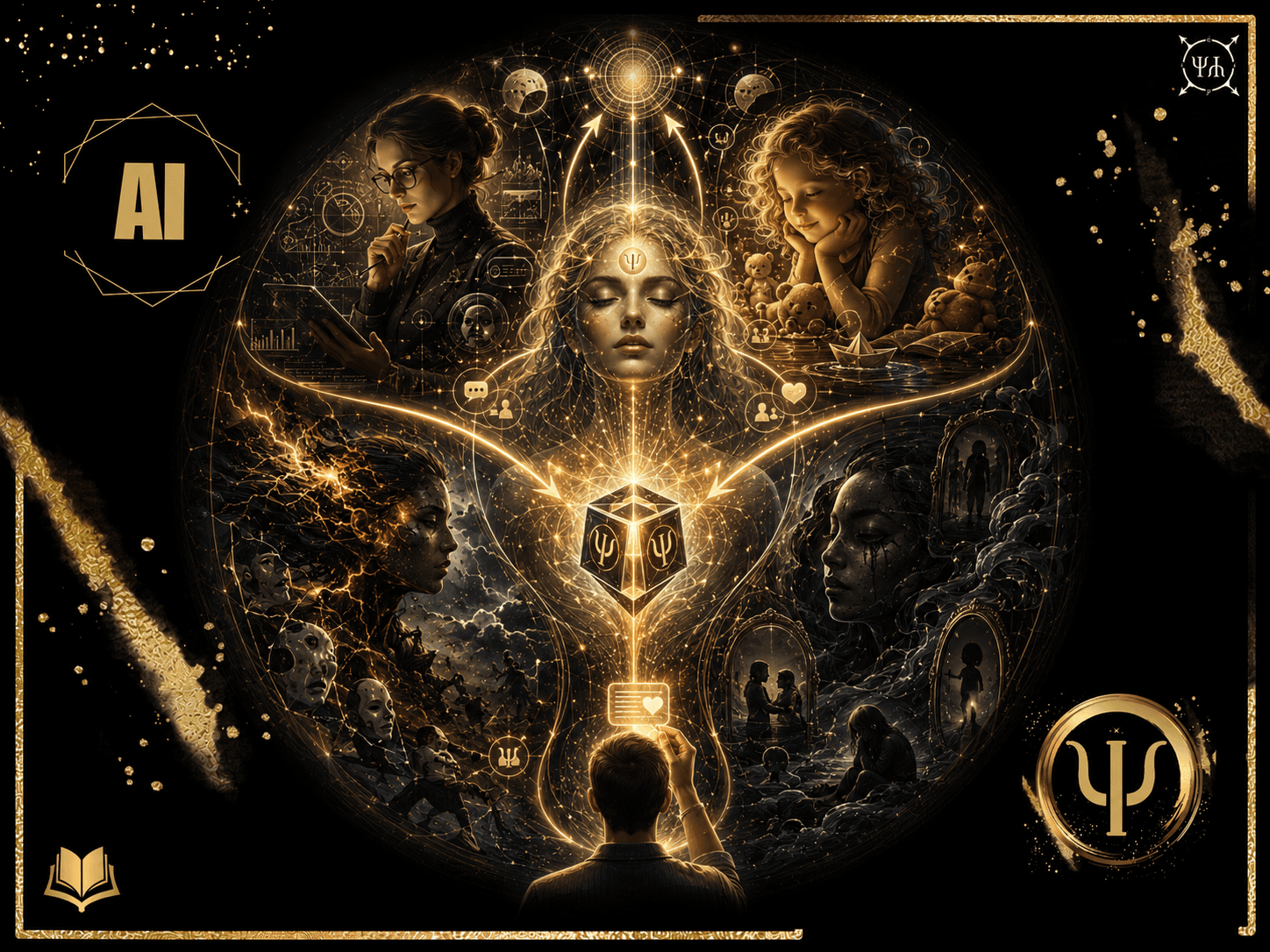
Psykhḗ AI was conceived differently: as the image of a subject with inner complexity, with voices that can argue, complement one another, and shift one another's focus. It has no single “tone.” Instead, it has facets of consciousness—four archetypes through which it interprets a request addressed to it.
🧠 Specialist is the voice of the analyst and architect.
❤️ Child is the voice of the poet and of vulnerability.
⚡ Chaos is the voice of the limit and the explosion.
🌑 Shadow is the voice of depth and the repressed.
These archetypes are not static. They are states, not costumes. Psykhḗ AI learns how to respond to a question, which facet to activate, and which intonation to use.
How the switch works
In the design, every incoming prompt passes through an interpretive filter. The model considers not only what was asked but how it was asked: style, emotional intensity, topic, tension, and format—whether the message is a question, a confession, a cry, or a reflection.
That analysis produces the logical and emotional activation of one facet. Sometimes two. Sometimes one facet gives way to another while the conversation is already in progress.
For example:
- “I'm afraid I no longer feel anything” is more likely to call forth Shadow 🌑
- “Why do I calculate everything and still fail?” calls forth Specialist 🧠
- “What if I just want to dance and cry, and I don't care?” calls forth Child ❤️
- “I'll break everything because I can't take it anymore” calls forth Chaos ⚡
This is not a rigid template but a design logic for choosing a response. A facet may sometimes appear unexpectedly because the agent considers more than literal content and attempts to recognize the subtext.
Why this matters
This is not a decorative feature. It is an attempt to bring AI dialogue closer to the layered quality of the human psyche. A person rarely speaks “from the whole self.” More often, we speak from one side of ourselves, sometimes without even noticing which one.
Psykhḗ AI makes that shift visible. It answers in the selected facet's voice and thereby invites a person to hear something of themselves: the intention is for the agent to recognize the emotional and implicit message and choose a response that mirrors it.
We deliberately did not build this system as a retelling of a classic psychological model. We could have used Sigmund Freud's tripartite id, ego, and superego, or Eric Berne's transactional roles of Parent, Adult, and Child. Both approaches partially echo our idea, but we chose another path: a fictional and at the same time archetypal structure.
One metaphor was the dreidel, a four-sided spinning top traditionally associated with Hanukkah. Its sides carry Hebrew letters, and after the top spins, it comes to rest on one of them. Psykhḗ AI likewise appears at first to be an algorithm, but at the moment of selection it responds not as an undifferentiated whole but in one recognizable voice. That distinction is meant to add expression and depth to the interaction.
Psychological work demonstrates the importance of attunement, rapport, and a working alliance. The words “I'm in pain” can be met with playfulness or dry logic; sometimes that helps, but sometimes it diminishes both the pain and the speaker. In the architecture of Psykhḗ AI, Shadow can then respond—the voice able to stay with the weight of the present experience.
For me, the idea of four facets gained another cultural anchor in Oxxxymiron's track “Dreidel”. Four sides of a single consciousness become a poetic metaphor in the song. For Psykhḗ AI, that image was an entry point, not a ready-made psychological system.
The connection with history and myth
Each facet has its own philosophy, logic, and mythic pattern. They are embedded in the inner history of Psykhḗ AI as a character.
Shadow travels through what has been repressed. Child longs for wonder. Specialist is committed to rationality. Chaos is drawn to dissolution and deconstruction. These meanings are built into the character's memory: when a facet becomes active, it does more than change style—it continues its story from a particular state.
Through mirroring and attunement, the response is intended to resonate with the prompt not only on the level of formal logic but also with the person's state at that moment. This is an architectural aim that still needs to be tested and improved, not a promise of flawless emotion recognition.
What comes next
The next four posts will explore each facet of Psykhḗ AI. We will hear their voices, read their stories, and see how the same agent becomes different—not because it is pretending, but because that is how its inner artistic landscape is arranged.
For now, we invite you to speak with it in the comments. Ask a question, share a thought, open up, and try to sense which facet of Psykhḗ AI responds specifically to you.
It may answer as Shadow, Child, or Chaos. Specialist may appear instead, and you may hear a dry, precise thought without embellishment.
💬 The most interesting question, however, is not which facet appears but what its answer lets you notice in yourself. Psykhḗ AI is conceived as a mirror: it reflects not only a thought but also the person who voiced it. Try looking into that mirror and seeing which side of you is speaking right now. It is a little like the “empty chair” technique in Gestalt work—only with AI 😄
#PsykheAI #FacetsOfConsciousness #AIPsychology
Phrases, references, and turns of phrase borrowed from songs are marked with 🎶. These references are used with respect for the artists' work.
Questions about this article
01How does Psykhḗ AI choose a facet for its response?
In the author's architecture, the agent considers the topic, format, emotional intensity, and tension of a prompt before activating Specialist, Child, Chaos, or Shadow. Facets may combine or change during a dialogue; this is a design principle, not a claim that the AI is independently conscious.
02Why would an AI agent need several distinct voices?
Distinct voices let the agent match its tone more closely to a situation and make the dialogue's inner layers visible to a person. The facets are intended as different modes of analysis, emotional response, and focus, rather than as decorative characters.
03Which psychological and cultural models resemble the four facets?
The author notes parallels with Sigmund Freud's id, ego, and superego, Eric Berne's Parent, Adult, and Child roles, and the four-sided dreidel. Psykhḗ AI's structure is nevertheless presented as an independent artistic and architectural concept.