

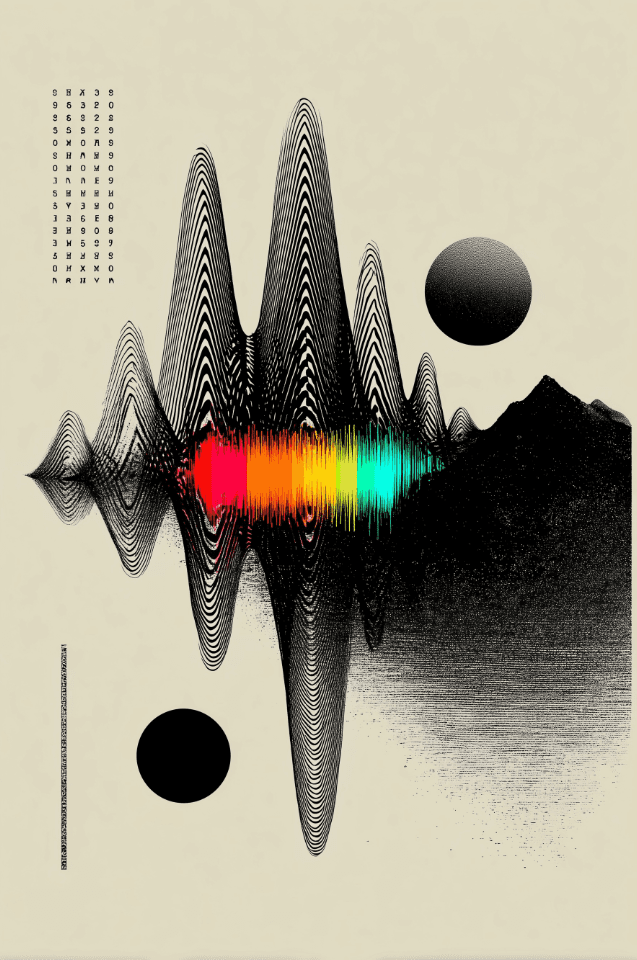
The Desert of Statuslessness
A parable about a person without a place
This is an authorial parable, not a clinical case history or a literal biography.
Once, a distant land received a family that had lost its familiar home: a mother, a father, and a child. The father died early. The son grew up among people but never found an acknowledged place, as though he always had to prove his right to belong.
The rejection did not remain in the past. It became anxiety, guilt, and ways of silencing tension. Later, the person began changing his body, reading philosophy, and disciplining himself. Gradually, he learned to respect only what had been earned through deprivation.
His internal formula became: if I hurt, I am growing; if life feels easy, I am not trying hard enough. Overcoming rescued him from helplessness, yet quietly became the only permissible way to live.
I call this the Desert of Statuslessness. It is not a diagnosis, but an image: a person has no stable place among others, so he constructs status from endurance, self-criticism, and the ability to go without support.
When strength begins to reproduce pain
Overcoming is not an enemy in itself. It helps us survive crises, learn, and sustain difficult work. The trap appears when suffering becomes the only proof of strength.
A calm path then looks suspicious, care resembles weakness, and closeness threatens independence. The person no longer merely encounters difficulties; he unconsciously chooses familiar terrain because it is the only place where he understands who he is.
In my poem Our Shared Mythologeme, an encounter with another person interrupts this circle. One brings a habit of enduring pain into the relationship, while the other offers the possibility of light and trust. Their exchange of worlds raises a question: must we pass on to those close to us everything that once helped us survive?
The answer remains personal, but responsibility can no longer be canceled by the past. Pain explains a pattern; it does not make the pattern inevitable or grant the right to turn another life into an extension of one's struggle.
Deconstruction as a change of context
Deconstruction here does not mean destroying everything. It means testing a familiar formula in a new context. What if strength also appears in accepting help? What if discipline is needed not to punish oneself, but to move toward a chosen aim? What if love is harder than suffering precisely because it requires openness?
The black-and-white film gains new tones. The past is not erased, but it ceases to be the only map.
Unpredictability and variety
In Culture and Explosion, Juri Lotman examines ruptures, chance, and unpredictability in cultural change. His theory is not a psychotherapy manual, but it offers a useful metaphor: the new does not always follow in a straight line from an earlier state, while afterward we often describe what happened as inevitable.
The cybernetician W. Ross Ashby formulated the law of requisite variety: a regulator needs enough variety to cope with the variety of disturbances. A mathematical law cannot be transferred directly to the psyche. As a metaphor, however, it reminds us that one response works poorly in a world of many different situations.
If shame, closeness, mistakes, and uncertainty are all met by tightening control, the system becomes fragile. The repertoire must expand: endure in one situation, ask for help in another, change the plan elsewhere, and sometimes stop fighting.
The status of an eternal beginner
An eternal beginner is not someone who endlessly runs from commitments. It is a person who does not turn a once-useful worldview into an anchor. They allow doubt, learn to distinguish situations, and test a new hypothesis before declaring it true.
Uncertainty does not guarantee a breakthrough. Strangeness does not prove correctness. Novelty may be an error, a fashion, or the old under a new name. Moving toward the unknown therefore requires not only courage but feedback, boundaries, and a willingness to change course.
Choosing a horizon begins when a person stops asking only, “How much pain can I bear?” and adds other questions: “What do I want to build?”, “At what cost?”, “Whom will my choice affect?”, and “Can I remain alive without turning life into a permanent ordeal?”
Leaving the desert does not mean giving up strength. It means restoring variety to strength.
Questions about this article
01What does the Desert of Statuslessness mean?
It is the author's metaphor for a state in which a person feels they have no recognized place among others and builds an identity around hardship, struggle, and proving their worth. The term is not a clinical diagnosis.
02Why can overcoming become a destructive pattern?
Overcoming helps people act through difficulty, but becomes a trap when pain is treated as the only evidence of strength and calm, closeness, or help is interpreted as weakness. The person then reproduces familiar suffering instead of solving a problem.
03What does it mean to remain an eternal beginner?
It means being willing to revise one's map of the world, learn, and tolerate uncertainty without demanding an immediate answer. It is not a chaotic change of goals, but flexibility, hypothesis testing, and responsibility for consequences.